 Param Vishisht Seva Medal (PVSM)
.svg) Ati Vishisht Seva Medal (AVSM) with Bar
Ati Vishisht Seva Medal (AVSM) with Bar
 Samanya Seva Medal (SM)
 Uttam Yudh Seva Medal (UYSM) & Yudh Seva Medal (YSM)
 Vishisht Seva Medal (VSM)
 Special Service Medals
 Indian Operation Vijay Star
 Operation Parakram Medal
 India High Altitude Service Medal
 Videsh Seva Medal
 India 50th Anniversary Independence Medal
 Indian 30 Years Long Service Medal
 Indian 20 Years Long Service Medal
 Indian 9 Years Long Service Medal
 UN UNAVEM medal
INTEGRATED BATTLE GROUPS (IBGs) – SWORD ARM OF EMERGING BATTLEFIELDS
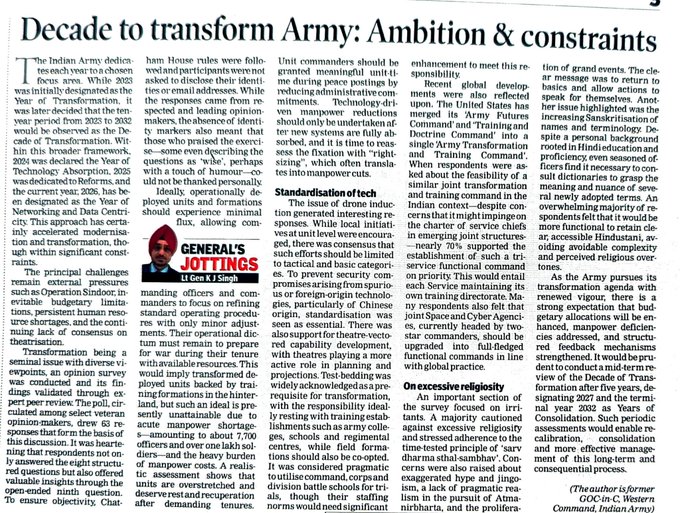
Indian Army has shifted gear in the quest for transformation. There is new doctrine taking shape, with evolving organizations- Rudra-IBGs, Bhairav-Light Strike Commando Battalions, Divyastra and Shaktibaan-drone and loitering munitions fire-units and Ashni-Drone platoons. Few well informed experts have termed these organizations, as instruments of transition from the erstwhile ‘Cold Start’ doctrine, to more offensive ‘Cold Strike’. The import of these reforms is to prepare Army for Multi Domain Operations, with compressed operation cycles, incorporating new generation weapons and technologies, like drones and long-range vectors.
Chinese Threat
To analyse these reforms, it is appropriate to start with Sun Tzu's seminal wisdom, “if you know the enemy and know yourself, you need not fear the result of a hundred battles”. Experts like Suyash Desai, who study China and PLA closely have opined that China has operationalized, new “cold start-style” military operational posture and deployment, with the goal of being able to conduct rapid, high-intensity, offensive operations, before an adversary can mobilize or intervene. This was also reiterated by Xi Jinping, in his recent directive, “Troops must keep training and be ready to fight at any moment”.
China has been practicing for 24–48-hour window of launch. While Taiwan in Eastern Theatre remains the primary focus, yet two India facing military districts, Xinjiang and Tibet, in Western Theatre, usually described as ‘ugly-ducklings’ have gained the maximum from this directive. Hence, it is axiomatic for us to create TFs like one applied in Operation Snow Leopard, that sprang unprecedented surprise, by pre-emptive occupation of Kailash heights in August 2020, as part of very successful quid-pro-quo (QPQ) manoeuvre. We need to have many such QPQ contingencies, with dedicated IBGs/TFs, lighter and agile ones, to effect dissuasive deterrence against PLA. There is also need to study, Chinese, Taiwan-centric maritime application model, to ensure that Navy is applied early in ‘cold start’ format, to leverage our asymmetry.
Evolution of Cold Start Doctrine
The sceptics could question this as a mere rebranding exercise but macro concepts like Cold Start/Strike and IBGs have matured over decades. The idea was born in the aftermath of Operation Parakram, coercive deployment, from 13 Dec 2001 to 16 Oct 2002. Unfortunately, ponderous month-long mobilization, prolonged nine-month deployment, 798 casualties and above all, political indecision, made it a strategic failure. The major lessons were, first- need for rapid mobilization; second- re-location and forward basing of formations from hinterland to closer to launch areas. Third and critical requirement was tailor-made, combined arms/services, task-focused and agile Task Forces (TFs).
It was initially referred to as Cold Start doctrine but was later repackaged as Short Notice Intense Pro-active Escalatory (SNIPE) operations, which was considered politically more appropriate. TF requirement was being met, somewhat, in ad-hoc manner by cobbling up, Divisional Sized Forces (DSFs). However, at least one Army Commander, citing Manekshaw analogy of 1971 operations, had asked for more preparation time, during Operation Parakram, for executing designated contingency. It is reported that he was overruled but he was justified in his plea and it did sow seeds of indecision. Hence, need is for TFs, now renamed as IBGs, not only organized but also trained and maintained in high state of readiness.
Transformation Study was carried out in 2009-10 and many initiatives like IBGs, SF TFs with supporting architecture were part of 25 odd KRAs. In Perspective Planning Directorate, we had a Director-Transformation tasked to implement these. Unfortunately, we didn’t find any traction with silo-based, turf-centric mind-set and lack of government support. Shift to agile formations and equipment is global trend reflected in Stryker Brigades and Agile Combat Employment (ACE) of USA and Brigade Combat Teams in UK. Russian Army suffered embarrassing losses, in initial phase of offensive in Ukraine due to over reliance on long armoured columns. Even on our Western Front, urbanization has altered the character of terrain to developed and semi-developed, with restricted avenues of application of large formations. This has also increased availability of high value objectives in shallow depth. Instead of deep forays, synergised multiple shallow strikes seem to be the way forward.
A study of our response matrix suggests preference for non-escalatory, yet calibrated targeting, more in the genre of long range vectored surgical strikes. These have been characterised by 24–36-hour operational cycles. An opening barrage, Pak retaliation, cognitive manipulation and closing round. While India has crafted nuanced space below nuclear threshold, yet international pressure may force exit options or off-ramping, after 72-96-hour. Notwithstanding, our preference for non-contact domain, this leaves out our huge big forces and contact kinetics can’t be ruled out. We have to be prepared for all types of warfare, as Pakistan has displayed audacious (fool-hardy) daring and desire to surprise us, coupled with resilience.
Challenges
The current initiatives will have to overcome usual challenges. In US Armed Forces, process follows, DOT-MLPF-P template, which stands for- Doctrine, Organization, Training, Material, Leadership, Personnel, Facilities and Policy. While it is indeed much needed and well-intentioned initiative, but are we applying a ‘jugaad’ solution? The entire re-organisation has to be affected against no manpower accretion by resorting to optimisation. The challenge is accentuated with Army already facing shortage of 1.8 lakh soldiers and 7,700 officers. Standardized equipment, especially drones, long range vectors have limited availability and long gestation period, ffor operationalization. Proliferation of drones, both hunter (surveillance) and killer (strike) variety is very welcome but it needs doctrine and standardization. It will be appropriate, if transformation and modernization is supported by budgetary allocation, delegation and flexibility in archaic manning norms.