 Param Vishisht Seva Medal (PVSM)
.svg) Ati Vishisht Seva Medal (AVSM) with Bar
Ati Vishisht Seva Medal (AVSM) with Bar
 Samanya Seva Medal (SM)
 Uttam Yudh Seva Medal (UYSM) & Yudh Seva Medal (YSM)
 Vishisht Seva Medal (VSM)
 Special Service Medals
 Indian Operation Vijay Star
 Operation Parakram Medal
 India High Altitude Service Medal
 Videsh Seva Medal
 India 50th Anniversary Independence Medal
 Indian 30 Years Long Service Medal
 Indian 20 Years Long Service Medal
 Indian 9 Years Long Service Medal
 UN UNAVEM medal
Clash Of Corridors-cpec- Under Finalisation
Introduction
In his book, Lt Gen (Dr) Kamal Jit Singh (Retd)—former GOC-in-Chief, Western Command, scholar-warrior, and national security strategist—presents a comprehensive analysis of how economic corridors are reshaping modern geopolitics.
One of the most significant strategic themes examined in his work is the concept of a “Clash of Corridors”, with the China–Pakistan Economic Corridor (CPEC) serving as a central and illustrative case study.
The Concept of “Clash of Corridors”
Lt Gen K.J. Singh explains that contemporary power competition is no longer driven only by territorial conquest or military confrontation. Instead, it increasingly manifests through:
- Large-scale economic and connectivity corridors
- Infrastructure networks with strategic and dual-use potential
- Control over trade routes, logistics chains, and access points
He conceptualises this phenomenon as a “Clash of Corridors”—a strategic contest where nations seek influence and leverage by shaping connectivity rather than altering borders.
CPEC as a Strategic Corridor
In his book, Lt Gen Singh analyses the China–Pakistan Economic Corridor (CPEC) as more than an economic initiative. He frames it as a strategic corridor with long-term implications for regional security.
Key dimensions highlighted include:
- Territorial sovereignty concerns, as the corridor traverses Pakistan-occupied Jammu & Kashmir
- Strategic access to the Arabian Sea and the Indian Ocean Region
- Infrastructure depth, including ports, highways, rail networks, and energy assets
- Potential dual-use character of civilian infrastructure
This overview reflects the core arguments developed in detail in the book.
Strategic Fault Lines Identified
Lt Gen K.J. Singh’s writing identifies several strategic fault lines arising from CPEC:
- The normalisation of infrastructure development in disputed territories
- The gradual transformation of economic projects into strategic assets
- Long-term implications for deterrence, stability, and regional balance of power
- The strategic signalling inherent in corridor-based geopolitics
These themes are explored comprehensively in his book, supported by operational insight and strategic reasoning.
Corridor Competition in a Global Context
The book places CPEC within a broader global trend, where competing powers are advancing alternative connectivity frameworks. Lt Gen Singh argues that:
- Corridors are becoming instruments of strategic alignment
- Economic connectivity increasingly influences security outcomes
- Competing corridors may intersect, overlap, or conflict in contested regions
This evolving competition forms the basis of what he describes as a new domain of strategic rivalry.
Why This Analysis Is Marked “Under Finalisation”
As emphasised in the book, the Clash of Corridors – CPEC is not a static or concluded phenomenon. The designation “Under Finalisation” reflects:
- Continuously evolving geopolitical dynamics
- Ongoing infrastructure expansion and strategic positioning
- Emerging alternative corridors and alliances
- The long-term nature of corridor-driven strategy
The strategic outcomes of these developments are still unfolding.
About the Book
General’s Jottings: National Security, Strategy & Leadership
This book brings together decades of operational military experience and strategic scholarship. The “Clash of Corridors”, including the detailed examination of CPEC, is a key analytical theme within a wider discussion on national security and future conflict.
The book provides:
- Full conceptual development of the “Clash of Corridors”
- In-depth strategic assessment beyond this overview
- Historical context and future projections
- A practitioner’s perspective on emerging security challenges
Conclusion
As articulated by Lt Gen (Dr) K.J. Singh, the Clash of Corridors – CPEC represents a defining feature of modern geopolitics, where infrastructure, economics, and strategy converge. While this page presents a detailed overview, the complete strategic vision is contained within his book—an essential read for anyone seeking to understand the future of security and power competition.
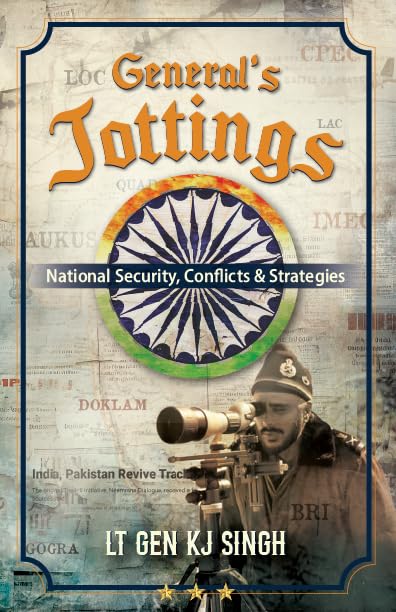
General's Jottings: National Security, Conflicts & Strategies
Buy Now