 Param Vishisht Seva Medal (PVSM)
.svg) Ati Vishisht Seva Medal (AVSM) with Bar
Ati Vishisht Seva Medal (AVSM) with Bar
 Samanya Seva Medal (SM)
 Uttam Yudh Seva Medal (UYSM) & Yudh Seva Medal (YSM)
 Vishisht Seva Medal (VSM)
 Special Service Medals
 Indian Operation Vijay Star
 Operation Parakram Medal
 India High Altitude Service Medal
 Videsh Seva Medal
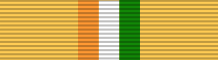 India 50th Anniversary Independence Medal
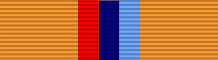 Indian 30 Years Long Service Medal
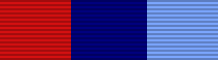 Indian 20 Years Long Service Medal
 Indian 9 Years Long Service Medal
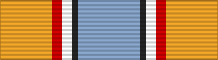 UN UNAVEM medal
Revamping China Response Strategy
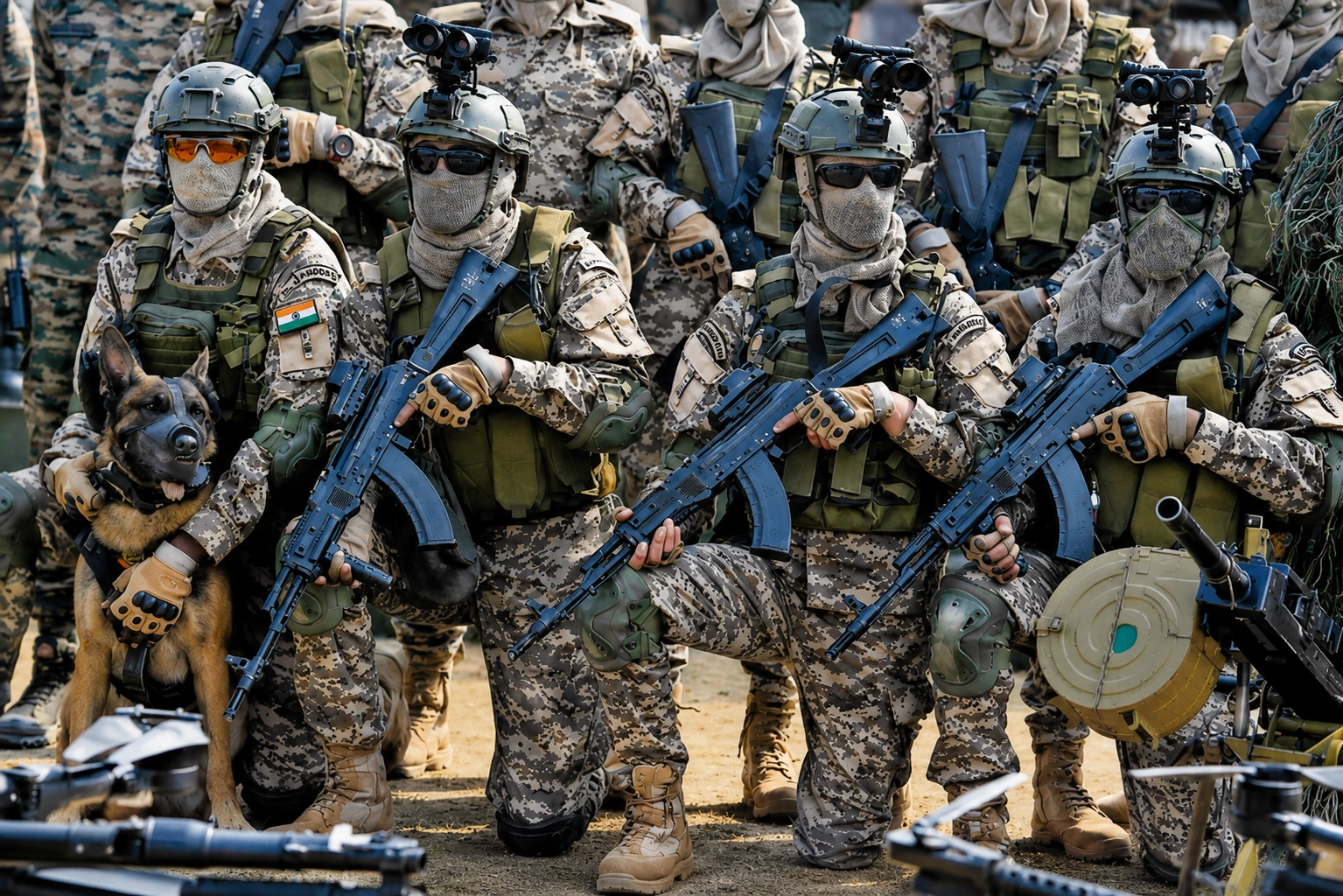
India recently celebrated the first anniversary of the ongoing Operation Sindoor. It is most appropriate to celebrate the execution of this very effective 88-hour "long" (really, "short") operation in an otherwise growing list of wars and conflicts dragging into unending stalemates. However, amid the cascading "Dhurandhar" hype, are we missing the most important lesson? The threat of a single "fused front" with Chinese collusion and orchestration.
The next plot worth examining for filmmakers could be something like "Jin-Rehman Files", with a Chinese djinn hovering between Gwadar and Lyari.
Starting with the 1962 aggression and, more recently, the Galwan and Yangtse incidents and the range of the PL-15E missile, China has repeatedly managed to surprise us. A regional Thucydides Trap is inevitable between India and China, notwithstanding the current capability differential and despite our sub-optimal capability development.
We have created many China-focused think tanks and study groups, yet Winston Churchill's description of Russia in 1939 as "a riddle wrapped in a mystery inside an enigma" still applies to our deciphering and understanding of China in 2026. A holistic review of these institutions is very much warranted.
Think Tanks
The earliest institution, Cheena Bhavana, was created in 1937 at Visva-Bharati University. It focused on socio-cultural and linguistic aspects. As a much-belated reorientation, it has recently started a certificate course in Chinese for Army personnel.
The humiliating reverses in the 1962 operations led to the creation of the first, but totally informal, China Study Group in 1969, comprising a group of scholars from universities under Giri Deshingkar. The group expanded into the Institute of Chinese Studies in the same year and was instrumental in publishing India's first China journal, China Report. This institution, which was the main think tank for decades, is now facing severe financial constraints and needs to be given structured fiscal stimulus.
The institute spawned the setting up of a number of Chinese and Mandarin language departments in universities and schools of foreign languages. Mandarin has now become an essential language for the ITBP, which needs to be proliferated further and graduate to dialect proficiency.
The institute has been marginalised to an extent by the formation of the Centre for Contemporary China Studies (CCCS) in 2017, headed by Lt Gen S.L. Narasimhan. It is a semi-autonomous think tank funded by the Ministry of External Affairs. It is currently headed by Lt Gen Y.K. Joshi and is divided into seven verticals, including foreign policy, internal developments, economy, science and technology, bilateral relations, and Chinese activities in our neighbourhood. As we transform to a theatre model, the CCCS should consider setting up functional extension cells in the theatres.
In addition to the CCCS, the Takshashila Institution in Bengaluru has emerged as an independent and credible research organisation. The Chennai Centre for China Studies is another think tank outside Lutyens' Delhi, though it is also facing fiscal challenges.
All premier think tanks in the capital, such as India Foundation, ORF, DPG, CLAWS, IDSA, USI, CAPS, NMF, Chanakya and ICWA, have China desks and resource persons. In contrast, according to noted Sinologist Srikanth Kondapalli, China has "focused leading small groups" to advise it on policies towards many countries, including India.
We seem to have a problem of lack of synergy, absence of academic and research rigour, and missing specialisation. Are too many bodies studying the same issues and copy-pasting each other? The first generation of Sinologists got past the Mandarin barrier and it was the translation phase in our understanding of China. The current lot has graduated to analytics, but in a reactive mode, figuring out incidents and shaping reactions. The future generation needs to graduate to predictive analysis to build long-term deterrence, dissuasion and hedging options. It is hoped that data analytics and AI will be harnessed to optimise our analytical endeavours.
China Study Group (CSG)
The CSG is a semi-formal, official and confidential group of top bureaucrats assembled periodically to advise the government on China policy. It was created by the Cabinet Committee on Political Affairs (CCPA) under the Indira Gandhi government in November 1975, initially headed by diplomat K.R. Narayanan (later President), with the secretaries of external affairs, defence and home as members.
The National Security Adviser (NSA) started steering the CSG after the institution of the appointment in November 1998.
The group currently comprises the Cabinet Secretary, the home, foreign and defence secretaries, the three vice chiefs of the armed forces, and the directors of the IB and R&AW.
The group has contributed significantly to defining patrolling limits in the form of Patrolling Points (PPs). As many as 62 PPs have been formulated for the Ladakh sector. It has also regulated norms on rules of engagement and the posture of troop deployment along the border with China. It also lays down priorities for infrastructure development.
In the complex mélange of roads in the Sino-Indian border region, the largest category is referred to as "CSG roads", along with ITBP, PMGSY and BADP roads.
Way Forward
Two former Army chiefs, in their memoirs, have highlighted the centrality of the CSG in our coping strategy for dealing with Sino-Indian crises. Many experts have questioned its informal character, constitution and especially its meeting frequency, which is crisis-driven and reactive. An extreme view is that it is a diffused instrument with no real accountability.
After my extensive interaction with China experts, a few issues emerged for consideration. First, the CSG needs formalisation through the promulgation of a stipulated charter.
Second, the frequency and periodicity of meetings should be fixed. Ideally, a minimum of quarterly meetings is proposed.
Third, contestation with China extends to multiple domains. The current reset in engagement was triggered by the pre-budget Economic Survey. The CDS, though currently invited, and the VCDS should be added, and selected experts in the domains of technology and economy should be co opted.
Fourth, the knowledge needs to be institutionalised in the form of annual reports, which can remain classified, but applicable portions and action points should be disseminated to theatres and commands.
Ideally, the CSG should graduate from a reactive study group to a predictive China Response Group (CRG).
(Author is former GOCin-C, Western Command, Indian Army)